
Start Here: Cleaning the Lens
Many people quietly suspect something is wrong with them — even when they’re functioning, working, and trying.
You might feel behind.
You might feel like everyone else figured something out that you missed.
You might feel like something about you just isn’t working the way it should.
Humia begins with a simple possibility:
Sometimes the lens just needs cleaning.
Not the person.
The lens.
This page will walk you through the basic idea behind humia.life.
If it resonates, you’ll know where to explore next.
Step 1 — Start With One Simple Idea
Humia begins with a very simple claim:
Your worth is a fact.
Not a belief.
Not a motivational slogan.
A fact of being human.
Think about what humans actually are.
Just a few among many amazing facts, we are living beings who:
-
feel joy and pain
-
form friendships and families
-
imagine things that don’t exist yet
-
care about fairness
-
make mistakes and learn from them
-
build cultures, tools, and communities
Those capacities are part of being human.
They exist before success, status, productivity, or approval.
From this perspective, worth isn’t something you earn.
It’s something that comes with being human.
That doesn’t mean life will be easy.
But it does mean something important:
Difficulty does not equal defectiveness.
Step 2 — Why Life Can Feel So Misaligned
If our worth isn’t the problem, why do so many people feel like something is wrong with them?
Humia uses a simple metaphor:
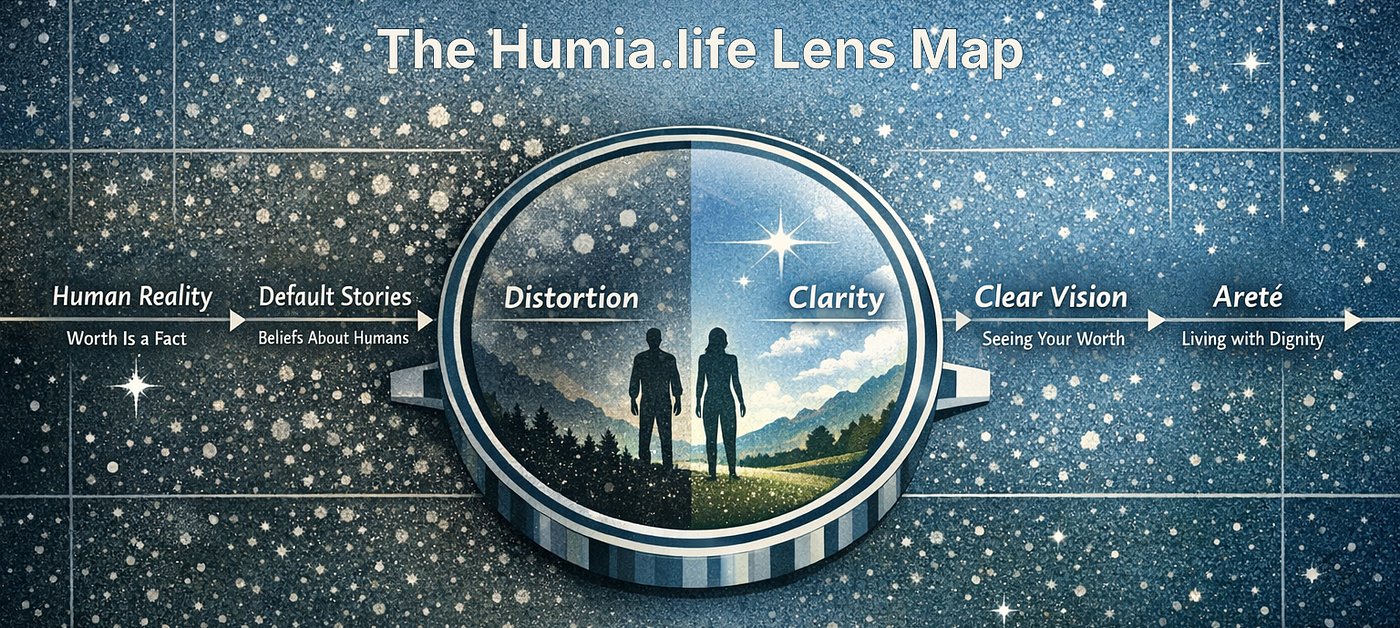
The Lens.
We all see life through lenses shaped by experience.
Over time, those lenses collect dust.
Some common sources of dust include:
-
stress
-
constant comparison
-
financial pressure
-
cultural ideas about success
-
stories about what humans are supposed to be
-
rapidly changing technology and social systems
When the dust builds up, it becomes harder to see clearly.
And people often start drawing painful conclusions:
-
“Maybe I’m just not good enough.”
-
“Maybe everyone else is better at life than I am.”
-
“Maybe something is wrong with me.”
But sometimes the problem isn’t the person.
Sometimes the lens just needs cleaning.
Step 3 — The Stories We Grew Up With
Most of us inherited powerful ideas about what humans are supposed to be.
These ideas come from all kinds of places:
family
religion
school
culture
work
media
Together they form something we can call the default human story.
Different cultures tell it differently, but the themes often sound familiar:
-
Humans are flawed and need fixing.
-
Your value comes from success.
-
Productivity proves your worth.
-
If you aren’t improving, you’re falling behind.
When people grow up hearing these messages, they often start interpreting normal human experiences in harsh ways.
Stress becomes weakness.
Struggle becomes failure.
Uncertainty becomes proof of inadequacy.
Cleaning the lens often starts with noticing those old stories.
Step 4 — Systems Matter Too
There’s another piece people often overlook.
We don’t live life in a vacuum.
We live inside systems.
Economic systems.
Work systems.
Social media systems built on comparison.
Technological systems changing faster every year.
These systems shape opportunity, pressure, and expectations.
When system pressure combines with harsh stories about human worth, many people reach the same conclusion:
“Something must be wrong with me.”
But often what people are experiencing isn’t personal failure.
Sometimes it’s a mismatch between human needs and the systems around them.
Seeing that clearly can be a huge relief.
It restores proportion.
Step 5 — What “Cleaning the Lens” Means
Humia isn’t about fixing yourself.
It’s about seeing more clearly.
Cleaning the lens usually involves things like:
-
noticing the stories we inherited about human nature
-
recognizing the pressures created by modern systems
-
separating our worth from our performance
-
understanding that responsibility and shame are not the same thing
-
reconnecting with the reality of what humans actually are
Clarity doesn’t create worth.
It just helps us see what was already there.
For many people, that recognition alone changes a lot.
Step 6 — Living With Clarity
Once the lens gets clearer, the goal isn’t perfection.
Life will still be messy.
But it becomes easier to live with dignity.
There’s an old Greek word that captures this idea: Areté.
It simply means living well by staying aligned with reality.
In everyday terms, that can look like:
-
using your abilities honestly
-
taking responsibility when you cause harm
-
repairing what you can
-
accepting limits where you must
-
living with self-respect even in imperfect systems
It’s not about becoming flawless.
It’s about living coherently as a human being.
Where to Explore Next
If these ideas resonate with you, the best next step is the Humia Library.
The library isn’t organized like a traditional blog.
Instead of dated posts, it’s a growing collection of evergreen pieces designed to help people think more clearly about:
-
human worth
-
systems and modern life
-
human psychology
-
responsibility and dignity
-
navigating uncertainty
-
living well in a changing world
You can start anywhere that feels useful.
Some people read one article and leave with a helpful shift in perspective.
Others spend time exploring the ideas more deeply.
Humia also offers a small number of guided practices and tools for people who want a more structured way to work with these ideas.
Supporting the Work
Humia exists to create and maintain resources that help people see themselves and the world a little more clearly.
If the work is helpful to you, there are simple ways to support it:
-
sharing the ideas with others
-
exploring the library and resources
-
participating in thoughtful discussion
-
supporting the project through its offerings if you choose
-
Becoming an ongoing supporter.
Support helps keep the work sustainable while allowing much of it to remain openly available.
One Last Thought
A lot of advice starts with the idea that you need to prove your worth.
Humia starts somewhere else.
Your worth is part of being human.
You are amazing. You matter.
Sometimes the lens just needs cleaning.