
Where AI Is Taking Us
Fear, Promise, and the Choice to Participate
Artificial intelligence is no longer a future concept. It is a present force reshaping how value is created, how work is organized, and how societies imagine security and meaning. The question is no longer whether AI will change the world, but how—and whether humanity will shape that change intentionally or surrender it to inertia, fear, and narrow interests.
Public conversation around AI often swings between extremes: utopian abundance on one side, civilizational collapse on the other. Both contain kernels of truth. Neither is sufficient on its own.
Humia approaches AI not as a destiny, but as a design space—one in which outcomes depend on human choices, institutional structures, and ethical orientation.
The Extreme Futures People Fear—and Hope For
To understand where AI may take us, we must acknowledge the full range of possibilities being discussed openly today.
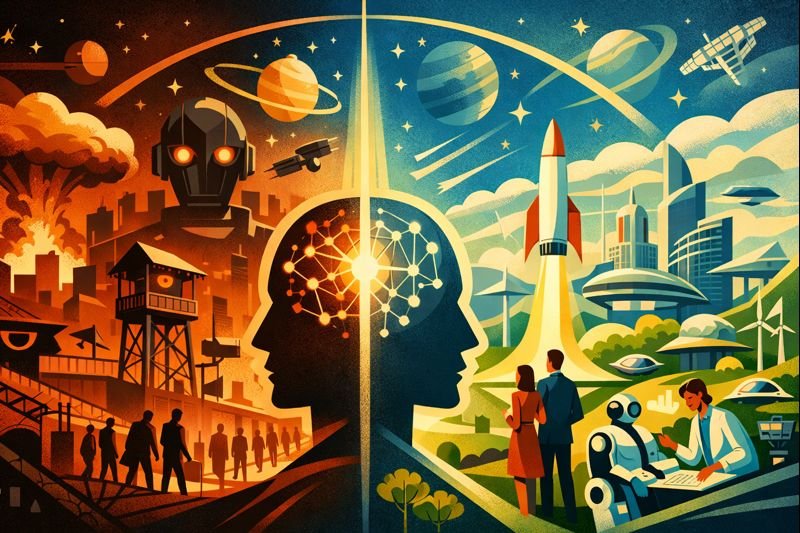
The Dystopian Trajectory
In its darkest framing, AI leads to:
-
Large-scale job displacement without replacement
-
Extreme concentration of wealth and power
-
Pervasive surveillance and behavioral control
-
Human deskilling and loss of agency
-
A society where most people are economically “unnecessary”
This future is not science fiction. It emerges naturally if AI is treated purely as a profit-maximizing tool, deployed inside systems already optimized for extraction rather than dignity.
The Utopian Trajectory
At the other extreme, AI is imagined as:
-
Eliminating scarcity in essential goods and services
-
Ending compulsory labor
-
Enabling universal access to education, healthcare, and creativity
-
Allowing humans to focus on meaning, care, and exploration
-
Creating shared prosperity through massive productivity gains
This future is also plausible—but only if systems are redesigned to distribute gains rather than hoard them.
The critical insight is this: AI does not choose between these futures. Humans do.
The Real Pivot: From Jobs to Value
Much anxiety about AI focuses on employment: which jobs will disappear, which will remain, and how quickly change will occur.
This focus, while understandable, is incomplete.
Historically, jobs have been the primary mechanism for distributing income. AI disrupts that assumption by breaking the tight coupling between human labor and economic value creation. When machines can generate enormous value with minimal human input, wages alone can no longer carry the weight of economic security.
The deeper question is not “What jobs will remain?” but:
-
How will value created by AI be shared?
-
Who benefits from productivity gains?
-
What counts as meaningful contribution in a post-scarcity trajectory?
Without intentional redesign, AI amplifies existing inequalities. With thoughtful system design, it can underwrite universal security.
The AI Dividend: A Design Principle, Not a Fantasy
The concept of an AI Dividend reframes the issue. Rather than tying survival to employment in a shrinking labor market, it recognizes AI as a collective inheritance—built on generations of human knowledge, culture, language, and labor.
An AI Dividend proposes that:
-
Productivity gains from AI should support broad economic security
-
Access to life essentials should not depend on constant labor competition
-
People should be free to contribute in diverse, human-centered ways
-
Economic dignity is a design requirement, not a moral afterthought
This is not about eliminating work. It is about liberating work from survival pressure, allowing creativity, care, learning, and community to flourish.
Why Avoiding AI Makes Outcomes Worse
A tempting response to AI anxiety is avoidance: slowing adoption, resisting tools, or hoping the wave passes.
History suggests this approach backfires.
When powerful technologies are avoided by the public, they are not abandoned. They are consolidated—controlled by fewer actors, shaped by narrower values, and deployed without broad oversight.
Engagement matters.
Ethical participation means:
-
Learning how AI systems work
-
Demanding transparency and accountability
-
Supporting open, humane, and public-interest models
-
Embedding dignity into design, not retrofitting it later
Avoidance cedes the future to those least likely to steward it well.
Working With AI as a Human Skill
The most resilient posture is not competition with AI, nor submission to it, but collaboration.
Working with AI can:
-
Extend human creativity rather than replace it
-
Reduce drudgery and cognitive overload
-
Amplify small teams and individual contributors
-
Enable new forms of education, care, and local resilience
This requires a shift in identity. Humans are not valuable because they out-compute machines. They are valuable because they interpret, care, imagine, judge, and relate.
AI can scale intelligence. It cannot define meaning.
The Ethical Line We Must Hold
A better future insists on several non-negotiables:
-
Human dignity is intrinsic, not conditional on productivity
-
Economic security must not depend on constant scarcity
-
Systems should expand agency, not erode it
-
Technology must serve flourishing, not domination
These are not technical constraints. They are moral ones—and they must be enforced through policy, culture, and collective expectation.
Where AI Is Taking Us—If We Choose
AI is taking humanity toward a crossroads.
One path leads to a world of abundance captured by the few, with the many left anxious, managed, and disposable.
The other leads toward shared prosperity, reduced suffering, and a redefinition of success grounded in human flourishing rather than endless extraction.
The difference between these futures is not intelligence. It is orientation.
Humia exists to help people see that this future is not something that happens to us. It is something we shape—through engagement, ethical clarity, and the courage to redesign systems that no longer fit the world we are entering.
AI is not the end of human relevance.
It is a test of whether humanity can mature into its own power.
And that test is already underway.