The Invisible Architecture of Inequality
Why the “American Dream” narrative fails by design
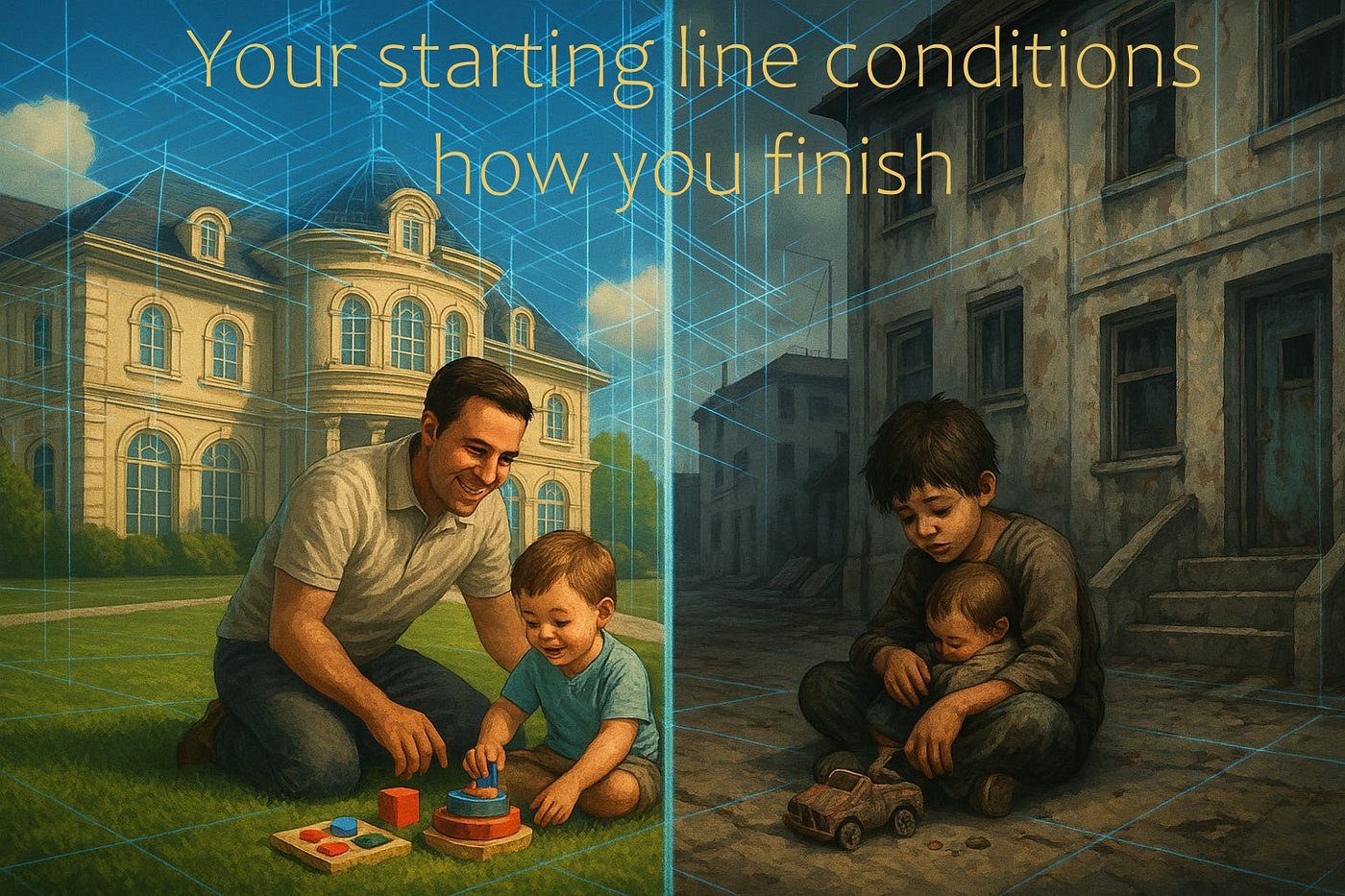
We’ve all heard the bedtime story: two kids, different families, same grit. Both have an equal shot at the “American Dream.”
Work hard enough. Hustle long enough. Believe in yourself.
And you too can make it.
It’s comforting. It’s motivating.
It’s also BS.
The truth is simple and uncomfortable: your starting line shapes your life trajectory far more than effort or talent alone ever could. That doesn’t mean you’re lazy. It doesn’t mean you’re broken. It means the system is structured to reward some paths and punish others—quietly, predictably, and at scale.
This is not a failure of individuals.
It’s the architecture of inequality.
The Rigged Race: How Systems Decide Who Gets Ahead
Inequality doesn’t require conspiracy. It only requires design choices that compound over time.
Education: Pay-to-Play by Zip Code
Wealthy neighborhoods fund schools through high property taxes, producing well-resourced classrooms, advanced courses, elite extracurriculars, and powerful college pipelines.
Poorer neighborhoods inherit the opposite: overcrowded classrooms, exhausted teachers, outdated materials, and limited opportunity.
One child begins with acceleration.
Another begins with drag.
Calling this “equal opportunity” is fiction.
Social Capital: The Unwritten Résumé
Wealth is inherited not only as money, but as access.
Some families pass down networks: internships, introductions, quiet recommendations, and institutional familiarity. Others pass down resilience—and locked doors.
If you’ve never been taught the unwritten rules, you don’t fail the game.
You were never given the rulebook.
Financial Systems: The Privilege of Failing Safely
Wealth buys forgiveness.
Affluent families can absorb failed startups, unpaid internships, relocations, and risk-taking. Failure becomes a learning experience.
For everyone else, failure is catastrophic. One medical bill, one car repair, one missed paycheck—and the entire plan collapses.
That’s not poor planning.
That’s asymmetric risk.
Healthcare: When Wealth Buys Years of Life
Money extends life expectancy.
Preventive care, safe environments, lower stress, clean air, and time to recover are not evenly distributed. Poverty shortens lives long before individual choices enter the picture.
This isn’t about discipline or character.
It’s about exposure.
The Cruelest Trick: Turning Structure into Shame
Here is where the system becomes most effective.
Instead of naming structural imbalance, it teaches people to blame themselves.
Struggling? You didn’t work hard enough.
Drowning in debt? Bad decisions.
Can’t get ahead? Not smart enough.
That narrative does real harm.
It converts design flaws into personal shame. It keeps people busy self-correcting instead of questioning the system itself. And it ensures that dignity is treated as something to be earned—rather than something intrinsic.
Recognizing this is not “making excuses.”
It’s restoring accuracy.
Playing Smarter in a Rigged System
Seeing the system clearly does not mean giving up agency. It means reclaiming it.
Clarity allows people to act without self-rejection.
-
De-personalize the struggle
Your worth is not a spreadsheet. Shame is not a motivator—it’s a control mechanism. -
Learn the unwritten rules
Financial literacy, networks, and soft power are not markers of superiority. They are tools. Understanding them is not selling out—it’s refusing to be naïve. -
Build collective leverage
Power concentrates upward; resilience is built laterally. Mutual aid, unions, and local cooperation work because they rebalance asymmetry. -
Redefine success
Systems built on hoarding want you chasing yachts and private jets. Redefine wealth as dignity, security, meaning, and the freedom to live fully human lives.
This is not about beating the system at its own game.
It’s about refusing to measure yourself by a rigged scoreboard.
From Myth to Design
The “American Dream” wasn’t stolen from most people.
It was never designed for them in the first place.
But recognizing that does not require despair or cynicism. It requires clarity.
Systems built on unequal starting lines can be redesigned. Narratives that protect concentrated power can be retired. And dignity does not need to be earned through suffering.
The real work ahead is not proving ourselves worthy within broken systems.
It is building systems where dignity is the starting point, not the prize.
That is not naïve optimism.
It is a design challenge.
And design can change.