Why Do I Feel So Behind in Life?
Many people quietly feel like they are falling behind in life.
Behind where they expected to be. Behind their peers. Behind the version of themselves they once imagined.
This page explores that experience in both video and written form.
Watch the companion video.
Read the Article:
Many people carry a quiet thought that surfaces at unexpected moments: “I feel like I’m behind in life.” It might appear while scrolling through social media, hearing about a friend’s promotion, or simply noticing how different life looks from what you once imagined. The feeling is rarely dramatic. More often it sits quietly in the background, shaping how people interpret their choices, their pace, and their progress.
When this feeling appears, most people assume the cause must be personal. They imagine they made the wrong decisions, lacked discipline, or somehow missed the correct path. Yet the sense of being behind is rarely explained by individual choices alone. In many cases it emerges from the stories and systems people inherit about what a successful life is supposed to look like.
From an early age, most people absorb an unspoken timeline about life. Education should finish at a predictable age. A career should begin quickly and progress steadily. Financial stability should arrive by midlife. Relationships and family milestones should unfold within familiar windows of time. These expectations often feel natural because they are repeated so consistently across culture, media, and institutions. But this timeline is not a law of human development. It is a social narrative shaped by economic structures, historical conditions, and collective expectations about productivity and success.
Real lives rarely follow a straight line. They unfold through health changes, family responsibilities, economic shifts, unexpected opportunities, and random events that no one could have predicted. When people compare their lives to a simplified cultural timeline, the comparison almost always produces distortion. The complexity of a real life is being judged against a story designed for clarity, not accuracy. This perspective helps how we see ourselves and others.
Modern life intensifies this distortion through constant comparison. Previous generations compared themselves mainly with neighbors, coworkers, or classmates. Today people are exposed to curated images of success from across the world, often stripped of context. Social media platforms amplify exceptional moments—promotions, achievements, travel, celebrations—while quietly omitting uncertainty, failure, and ordinary struggle. Over time this creates the impression that most people are advancing quickly while you alone are moving slowly.
Psychologists have long observed that social comparison plays a powerful role in how individuals evaluate their own lives. When people see carefully curated successes without the surrounding context, they often underestimate their own progress and overestimate the stability or happiness of others [1]. The result is a persistent illusion that life operates like a scoreboard, with visible winners and lagging participants.
Another distortion appears when societies begin measuring human value primarily through productivity. Modern economic systems reward outputs that can be easily counted: income, promotions, measurable achievements, and visible contributions to organizations. These metrics are useful for markets and institutions, but they are extremely narrow ways of evaluating a human life. Psychologist Barry Schwartz has written about how modern cultures of optimization encourage people to treat themselves as ongoing improvement projects, constantly measuring whether they are maximizing performance [2]. While this mindset can sometimes increase efficiency, it can also produce chronic dissatisfaction when people begin evaluating their entire existence through productivity metrics.
When productivity becomes the dominant measure of worth, many decent people begin to feel inadequate even when they are living thoughtful, responsible lives. The problem is not necessarily the person. The problem is that the measuring system captures only a small portion of what it means to be human.
Real human lives unfold through a wide range of factors that rarely fit into a simple timeline. Health, personality, economic conditions, opportunities, relationships, and unexpected events all influence the direction a life takes. But one of the most powerful influences often receives less attention than it deserves: the expectations and pressures within families themselves.
Families are usually trying to help. Parents often want security for their children. They want them to avoid hardship, find stability, and live lives that appear successful by the standards they understand. But even well-intended guidance can create powerful pressures when it narrows the range of acceptable paths.
Sometimes the tension appears when a young person’s interests or temperament point in one direction while family expectations point in another. A child may feel drawn toward art, research, social science, or community work, while family members push toward careers that appear safer, more respectable, or more aligned with their beliefs. When this happens, many people quietly learn a difficult lesson very early in life: approval may depend on becoming someone different from who they naturally are.
For some people, this pressure goes deeper than career expectations. Childhood experiences—both positive and painful—shape how safe it feels to explore one’s identity and curiosity. In my own case, I experienced sexual abuse by neighbors when I was young. The confusing part of that experience was not only what happened, but the fear of being blamed or punished if anyone discovered it. Like many children in similar situations, I was more afraid of how adults might react than I was of the people causing the harm.
Experiences like that can shape a person’s curiosity about human behavior and social systems. They can spark questions about how communities understand the human body, sexuality, power, and safety. Later in life, when I told my father I was interested in studying sociology and psychology—subjects that seemed like a safe and neutral way to explore those questions—he dismissed the idea. From his perspective, the Bible already explained everything necessary about human behavior.
That response was not unusual for many families shaped by strong religious or cultural traditions. But it had a long-term effect. Rather than pursuing the subjects I was genuinely curious about, I spent many years trying to follow a path that would meet family expectations. In my case that meant participating in the multi-level marketing industry that my parents believed in. It took a long time to recognize that much of that effort was driven less by personal interest than by the hope of gaining approval.
Experiences like this are far more common than people often realize. Many adults look back and recognize that the path they followed was shaped partly by family expectations rather than by their own curiosity or temperament. Some people eventually change direction. Others continue along the path because changing it feels too disruptive or disloyal.
None of this means families are villains. Most parents genuinely want their children to succeed and be safe. But it does illustrate something important: the forces shaping a life are rarely limited to individual effort or talent. They include family culture, belief systems, opportunities, fears, and the emotional dynamics of belonging.
When people later feel “behind” in life, they often overlook these influences and judge themselves as if every decision were made in perfect freedom. In reality, most lives are shaped by a web of influences that begin long before adulthood. Recognizing that complexity does not remove responsibility for choices, but it restores a sense of proportion about how those choices were formed.
Another important distortion appears in how people interpret success and failure. Modern culture often tells a simple story: people who succeed must have worked harder or made better decisions, while people who struggle must have made mistakes. Although effort and judgment certainly matter, this story dramatically underestimates the role of circumstance.
Research in psychology and behavioral economics has shown that human outcomes are strongly shaped by context, opportunity, and timing. Daniel Kahneman’s work demonstrates how easily people attribute outcomes entirely to personal qualities while overlooking the role of randomness or structural conditions [3].
Journalist Malcolm Gladwell explored this dynamic in depth in his book Outliers, which examines how success is often influenced by factors that individuals do not control: the year someone was born, the opportunities available in their community, the timing of technological changes, access to mentorship, and even small advantages that accumulate over time [4].
When those contextual advantages exist, success can appear natural or inevitable. When they are absent, even talented and hardworking people may struggle to gain traction. From the outside, however, observers often compress these complex influences into a simple explanation about personal merit.
This distortion does not only affect how people judge others. It also shapes how they judge themselves. When life unfolds differently from the expected timeline, many people assume they must have done something wrong. They overlook the role of chance, family context, economic shifts, health, geography, or simple timing.
The folk tradition has long recognized this truth more clearly than modern merit narratives sometimes do. Joan Baez captured it powerfully in her song There But For Fortune, which reminds listeners that the line separating success and hardship is often thinner than we like to imagine. The song’s refrain suggests a humbling possibility: the circumstances shaping another person’s life could easily have been our own.
Recognizing the influence of circumstance does not mean abandoning responsibility or effort. Instead, it introduces a healthier understanding of proportion. Human lives unfold at the intersection of personal choices and larger systems of opportunity, culture, and chance. When people forget this complexity, they often turn life outcomes into moral judgments about worth.
When that happens, the narrative of being “behind” becomes even heavier than it needs to be.
Clarity begins when we recognize that life is not a perfectly controlled race. It is a complex landscape shaped by both agency and circumstance. Understanding that complexity does not eliminate the desire to grow or contribute. But it can loosen the harsh belief that every deviation from a cultural timeline represents personal failure.
When these influences are considered together—family expectations, cultural timelines, economic pressures, and the unpredictable role of circumstance—it becomes easier to see how the feeling of being “behind” can emerge even in thoughtful and responsible lives.
The experience is often less about failure and more about interpretation.
Humans naturally interpret their lives through the stories available to them. Those stories come from religion, family culture, economic systems, education, and the social environments people grow up inside. Over time they form a kind of mental lens. Through that lens people decide whether they are succeeding, failing, ahead, or behind.
But lenses can distort as easily as they can clarify.
A person whose life has been shaped by family pressure may interpret delayed exploration of their interests as personal weakness. Someone navigating economic instability may interpret structural conditions as evidence that they lack discipline. Someone who experiences unexpected hardship may believe they have permanently fallen off the “correct” path.
In each case, the interpretation may feel convincing, even inevitable.
Yet the underlying reality is often much simpler: a complex life is being judged by a simplified story.
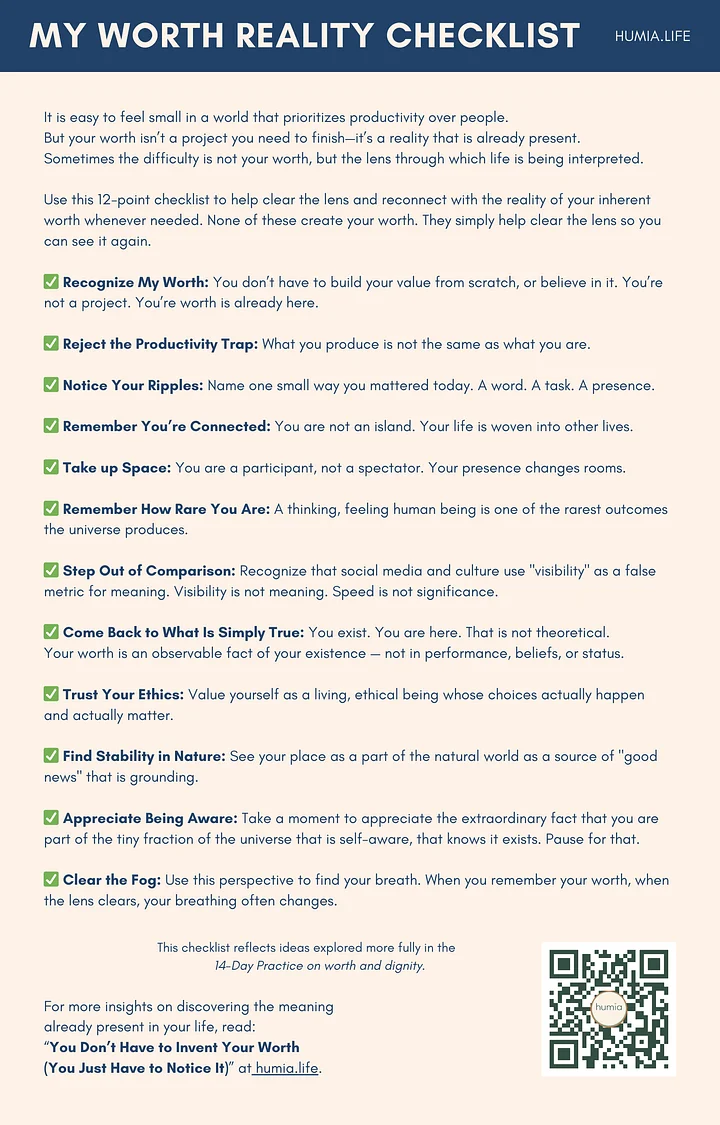
The Humia perspective begins with a different assumption. Instead of asking whether a person has earned their place through achievement or progress, it begins with a factual premise: human dignity is not something people manufacture through performance. It is a condition of being human.
From that perspective, the work of reflection changes slightly. The goal is not to invent worth through constant improvement. The goal is to clean the lens through which life is interpreted.
When the lens becomes clearer, something interesting happens. The harsh narrative of being “behind” often gives way to a more accurate understanding: life has simply unfolded through a particular set of circumstances, influences, and choices.
That understanding does not remove responsibility or effort. But it restores proportion, allowing people to evaluate their lives with greater realism and far less unnecessary shame.
At Humia, the goal is not to replace one motivational narrative with another. Instead, the goal is clarity. A helpful metaphor is the lens of a telescope. Cleaning the lens does not create the stars in the sky; the stars were already there. Cleaning the lens simply allows them to be seen more clearly. Human worth operates in a similar way. A person’s dignity does not appear because they achieve enough milestones or produce enough measurable outcomes. It exists as a basic fact of being a conscious human life capable of thought, care, and participation in the world.
When cultural stories distort how people interpret their lives, that reality becomes harder to see. The work of restoring perspective is not about manufacturing worth through constant self-improvement. It is about recognizing when inherited narratives no longer match the complexity of real human lives. Once that distortion is noticed, the pressure of being “behind” often begins to loosen.
Recognizing this distortion does not remove every difficulty. Economic pressures, health challenges, and uncertainty remain real parts of life. But clarity restores proportion. It separates the genuine challenges people face from the unnecessary belief that their existence must be justified through constant forward motion.
Instead of asking whether you are ahead or behind, a more useful question often becomes: What story am I using to measure my life? When that question is examined honestly, many people discover that the timeline they feel pressured by is not a universal truth but an inherited narrative shaped by systems and expectations.
Sometimes the most important shift begins with something very simple. Before measuring your life against a timeline or comparing it to others, pause for a moment and notice something obvious but easy to overlook: you are here, living a human life with all its complexity and variation. Recognizing that fact does not solve every problem, but it restores a sense of proportion that modern systems often obscure.
The question is rarely whether you are behind in life.
The deeper question is whether the story measuring your life was ever accurate to begin with.
Notice you’re here. That matters.
References
-
Festinger, L. (1954). A Theory of Social Comparison Processes. Human Relations.
-
Schwartz, B. (2004). The Paradox of Choice: Why More Is Less. HarperCollins.
-
Kahneman, D. (2011). Thinking, Fast and Slow. Farrar, Straus and Giroux.
-
Gladwell, M. (2008). Outliers: The Story of Success. Little, Brown and Company.
-
Baez, J. (1964). There But for Fortune. Written by Phil Ochs. Recorded by Joan Baez on Joan Baez/5. Vanguard Records.
Support This Work
Humia.life exists to explore human dignity, systems, and the stories that shape how people understand their lives. If you find value in this work and would like to help keep it independent and available to others. Your support helps sustain the research, writing, and tools that make this work possible. Whether you choose to contribute or simply continue reading, you’re welcome here.