Asking for Help Is Not Weakness
A personal confession and a practical framework
I need to say something plainly.
As I write this, I am struggling.
Right now I am managing health issues. I am managing financial strain. I am navigating obstacles, paperwork, uncertainty, and fatigue. And I have been hesitating to call agencies that exist specifically to help people in situations like mine.
Part of that hesitation is practical. I am tired. I worry about red tape. I worry that funds will be gone. I worry about long phone trees and being told no.
But the deeper hesitation is harder to admit.
Somewhere in me is a story that says needing help means I failed.
If you are reading this while facing your own version of strain — medical, financial, emotional, bureaucratic — you may know that story too. It is quiet but powerful. It says that competent adults should not still be here. It says that if we had made better decisions, moved faster, optimized better, we would not be navigating assistance programs.
That story does not come from nowhere. It is reinforced by systems that measure value in productivity, independence, and upward motion. And when life does not move in a straight line, the system does not adjust its metrics. It simply leaves you feeling behind.
In my case, there is something more layered.
Over the past couple of years, I have already asked for help. I have received generous support from my UU Fellowship. Friends contributed through a GoFundMe and in other ways. Several agencies stepped in when I needed them. People showed up for me in real, tangible ways. For that I am deeply thankful.
But when help has already been given, a new resistance forms.
It becomes harder to still be the one who needs help.
Gratitude mixes with embarrassment. Relief mixes with fatigue. There is a quiet pressure that says, “Surely by now you should be standing fully on your own again.”
That pressure is powerful.
Part of the reason I work so hard on humia.life is that I want to create something of value. I want to contribute. I want reciprocity, not rescue. I want support to flow from the value I create rather than from emergency stabilization. I have hoped that if I build humia.life fast enough, succeed clearly enough, that I will not have to ever ask for this kind of help again.
That desire is good.
But it is also avoidance.
The truth is that no one builds a modern life alone. Not individuals, not companies, not even the wealthiest people in this country. Every success story rests on public infrastructure, public law, public research, shared systems.
If that is true, then using systems when I need them is not weakness. It is participation in the systems we all live inside.
That does not mean the systems are perfect. Many are bureaucratic, underfunded, and misaligned with inherent human dignity. But misalignment does not erase their existence. It simply makes navigation more procedural.
And that is where I have had to shift my thinking.
Knowing something intellectually does not dissolve the feeling attached to it. Stories about self-sufficiency attach to identity. They do not vanish because we can argue against them.
At 64, I carry a narrative that I should not still be navigating assistance programs. That needing help again means I am behind. That generosity already received should have permanently solved everything.
But “should” is not a structural category.
Eligibility is. Circumstance is. Biology is. Systems are.
Health issues do not consult pride. Aging does not ask permission. Economic conditions do not negotiate with identity.
If human worth is truly inherent, then it does not decrease when someone applies for utility assistance, transportation help, or benefits counseling — even if they have received help before. Worth is not a meter that declines with each act of support.
Needing help does not alter that fact.
Asking for help is not collapse. It is navigation.
Calling an agency is a task. Filling out a form is a process. Receiving assistance is not humiliation; it is expense stabilization. Reducing pressure is not failure; it is strategy.
The system is imperfect. There is no magical pool of money waiting to be claimed. Assistance is fragmented and conditional. Some programs provide direct financial help. Others provide case management or referrals. Some will say no.
That does not make help unreal. It makes it procedural.
If I want to approach this coherently, I need to treat it as a sequence of steps rather than a moral referendum on my character.
That is not desperation. It is method.
One of the tools I am using right now is AI — not to search for “free money,” but to create structure.
Here is the type of prompt I am using:
Create a verified contact sheet of government agencies, nonprofit organizations, and veteran-specific programs serving Sarasota County, Florida.
Focus on programs that help with emergency financial assistance, utility bills, housing stabilization, transportation support, veteran benefits navigation, disability application assistance, healthcare access, and food assistance.
Only include real, currently operating organizations. Programs may be national, state, or local, but prioritize programs that serve my area. Distinguish between direct financial help and referral services. Include eligibility in plain English. Provide phone numbers, websites, and a short suggested call script. Sort by priority level.
Goal: I am a 64-year-old Florida resident and veteran trying to stabilize finances and transportation while pursuing disability benefits. I have limited energy and need the most actionable starting points first.
The important part is not my exact situation. The important part is clarity.
I state my age.
I state my veteran status.
I state that I have limited energy.
I state the specific problems I am trying to solve.
The output is not magical. It is a structured list: Area Agency on Aging, Veteran Services, utility programs, transportation options, food resources, nonprofits. Some provide direct financial help. Some provide navigation. Some provide referrals.
It is not a lottery.
It is a map.
If your situation is different, change the prompt.
If you are 32 and navigating medical debt, say that.
If you are a single parent facing eviction, say that.
If you are caring for an elderly parent, say that.
If you are unemployed and trying to stabilize transportation for work, say that.
State your age.
State your location.
State your constraints.
State your energy level.
State the specific pressure points.
Ask for structure, not miracles.
After receiving the list, I narrow it further:
“From this list, identify the five highest-probability resources most likely to provide near-term help. Be conservative and realistic.”
That reduces overwhelm. It turns anxiety into sequence.
AI can organize information. It cannot guarantee outcomes. I still need to call. I may hear no. I may be redirected. I may have to follow up.
That does not mean I was wrong to try.
It means I am navigating a system that does not automatically reflect inherent human worth, but still contains procedural pathways for assistance.
I also need to say something clearly.
Suffering is not in any way noble. Hardship is not spiritually assigned. I do not believe pain automatically refines people. I find romanticizing struggle to be misleading, disgusting, dehumanizing, and often very harmful.
But contact with constraint can clarify reality.
It can expose which narratives were fantasy.
It can reveal which systems are friction-heavy.
It can show where dignity still holds — even under pressure.
That clarity is useful. Not because hardship is sacred. Because clarity is useful.
If humia.life cannot survive the fact that I have needed help more than once, then it was built on performance rather than dignity. If this framework only applies when I am financially comfortable, it is incomplete.
I want reciprocity. I want contribution. I do not want perpetual stabilization.
But until that is structurally true, I am still a human being living inside shared systems that are not always aligned with inherent human dignity. That is sadly true for millions, not just me.
So this is my confession and my decision.
I am going to seek the help I still need.
Not because I am weak.
Not because I am defeated.
Not because generosity already received disqualifies me from more support.
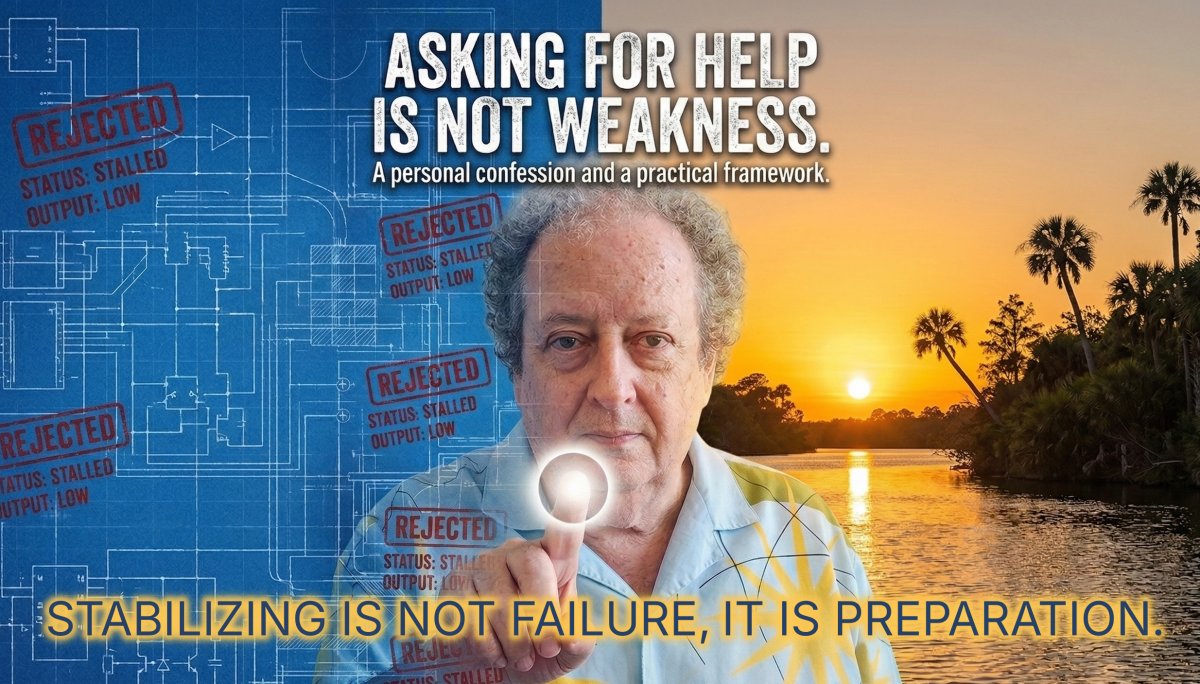
But because stabilizing is not failure. It is preparation.
And asking for help does not reduce dignity — even when you have had to ask before.
That is true for me, that is true for you.
Holding onto your dignity while navigating assistance programs — even when they feel bureaucratic or impersonal — may be one of the most honest and human acts available.