

Why You Might Not Need to Fix Yourself to Live Well
Self-Improvement, Areté, and the Myth of Earned Worth
There’s a quiet sentence many people carry for years:
“I’m behind.”
Behind where you thought you’d be by this age.
Behind people you went to school with.
Behind the version of yourself you were “supposed” to become.
Sometimes it shows up as motivation.
Sometimes as guilt.
Sometimes as exhaustion dressed up as discipline.
Often, it just hums in the background, making rest feel undeserved.
This essay is not an argument against effort or change.
It’s an argument against turning your life into a permanent improvement project.
Because growth is not a moral requirement.
And worth is not something you earn by fixing yourself.
There’s a cleaner, steadier way to think about living well—one that doesn’t require a treadmill to stay upright.
That way is Areté.
Two questions that shape two very different lives
Self-improvement and Areté can look similar from the outside. Both may involve learning, habits, therapy, discipline, or change.
But they begin from different ground.
Self-improvement asks:
“How do I make myself better?”
It usually assumes:
-
the current version of you is insufficient
-
progress must be visible, measurable, or performable
-
rest is a delay in becoming acceptable
-
there is always a next level
Even when it’s well-intentioned, the underlying logic is often:
“I am not enough yet.”
That logic produces a familiar pattern: tracking, optimizing, correcting, comparing—forever. Self-improvement rarely has a stopping rule.
It creates chronic self-surveillance.
Areté asks:
“What is the most fitting way to live, given what I am and the conditions I’m in?”
Areté is an old word that points to excellence as alignment—the way something functions well as what it actually is. Not maximized. Not perfected. Properly used.
Applied to a human life, Areté means:
-
alignment with reality
-
coherence between capacity, context, and action
-
excellence as fit, not escalation
Its underlying logic is simple and radical:
“I already have inherent worth.”
That’s not a slogan. It’s a factual claim.
A human being is a kind of being that can feel, learn, affect others, and be affected by others. Those capacities exist before achievement, before contribution, and before moral success. They don’t turn on only when someone behaves well, performs well, or lives up to an ideal.
If worth depended on productivity, independence, intelligence, or moral consistency, then infants, the elderly, the disabled, the traumatized, and the sick would drift in and out of worth. Most people instinctively reject that conclusion—not because it’s sentimental, but because it contradicts lived reality.
Humia.life treats human worth the way we treat gravity or vulnerability: not as a reward, but as a condition that already exists and has to be accounted for.
You can still argue about responsibility, behavior, and consequences.
But those arguments only make sense after you recognize what kind of being you’re dealing with.
So action flows from clarity, not inadequacy.
This isn’t a motivational difference.
It’s a nervous-system difference.
Self-improvement feels like someone is always checking your work.
Areté feels like orientation—knowing where you are before deciding where to go.
Three ordinary moments where the difference matters
1. Midlife fatigue
You wake up tired. Not dramatically—just bone-deep tired. The kind that doesn’t go away with a weekend.
Self-improvement whispers:
Push through. Others manage more. You’re letting yourself slip.
Areté asks:
What is actually happening in this body? What kind of excellence includes limits, aging, and rest?
Sometimes the most fitting action isn’t optimization.
It’s honesty.
2. Addiction recovery
Someone in recovery already knows they’ve caused harm. Shame isn’t missing—it’s often overflowing.
Self-improvement says:
Become a better version of yourself. Prove you’re serious.
Areté says:
You already count. Now let’s figure out what responsibility and repair look like from here, without destroying what’s left of your agency.
Shame doesn’t restore agency.
Clarity sometimes does.
3. Career panic
You look around and think, I should be further along by now.
Self-improvement treats your life like a delayed résumé.
Areté asks:
Given your history, constraints, skills, health, and actual opportunities—what is a coherent next step?
Not the most impressive one.
The most fitting one.
The subtle cruelty of “becoming your best self”
Many people replace harsh comparison with gentler metaphors, like the acorn principle:
An acorn becomes an oak, not a redwood.
That’s an improvement. It rejects imitation.
But it often still smuggles in performance:
-
there’s a “fully realized” version you’re meant to become
-
failure looks like not becoming that version
-
it assumes enough time, health, stability, and opportunity
Under real hardship, the message quietly becomes:
“You were meant to be an oak—if only conditions had allowed.”
Areté goes further.
An acorn is already a valid acorn.
A storm-scarred, crooked oak has not failed at being an oak.
Excellence is not reaching an ideal form.
It is fidelity to actuality.
This is a core Humia.life claim:
You’re not rejecting growth.
You’re refusing to make the future shape the moral test of being human.
If worth isn’t earned, what motivates change?
This is where many people get uneasy.
If shame goes away, what’s left?
Doesn’t pressure keep people moving?
Sometimes. But pressure also produces hiding, burnout, and backlash—especially under chronic stress.
Areté motivates differently.
When people are no longer defending their right to exist, energy becomes available for responsibility, learning, and repair.
Not because they fear losing worth.
Because they can finally see what’s real.
Areté doesn’t say “never change.”
It says: don’t turn your life into a probation sentence.
The hardest test: harm, responsibility, and repair
Any framework that claims worth is factual—not earned—must face the hardest question:
What about real harm?
Addiction. Violence. Racism. Abuse. Choices that hurt other people.
This is where many philosophies collapse into one of two failures:
-
Punishment theater: You forfeited your worth.
-
Denial: Everything is excused.
Humia.life refuses both by separating what is usually tangled together.
Worth
Non-negotiable.
Human dignity is not a reward for good behavior. If it were, it wouldn’t be dignity—it would be conditional status granted by power.
A person does not stop being human because of what they have done, or what has been done through them.
Responsibility
Real and contextual.
Responsibility asks:
-
What choices were actually available?
-
What constraints were present?
-
Where was power located?
-
What capacities were intact at the time?
Context does not erase consequences.
It makes response accurate instead of performative.
This matters especially for systemic harm.
White supremacy as a stress test
White supremacy is not sustained primarily by individual hatred. It is sustained by default norms, institutional inertia, silence, and unequal power.
Responsibility therefore routes through white people—especially white men—not because of inherited guilt, but because repair cannot happen without those positioned with leverage.
This is structural responsibility, not moral condemnation.
It means:
-
refusing to offload the cost of repair onto those already harmed
-
interrupting harmful defaults
-
accepting discomfort without collapsing
-
changing policies, practices, and narratives
Self-improvement often says:
Become a better person so you’re not complicit.
Areté says:
Live excellently as someone who is already implicated.
Repair
Forward-facing and concrete.
Repair may involve:
-
accountability
-
boundaries
-
restitution
-
changed behavior
-
consequences
But it does not require identity collapse or endless self-punishment.
A key Humia.life line:
Repair without dignity becomes punishment theater.
Dignity without repair becomes denial.
Areté requires both.
And this is not lenient. It removes both the excuse of shame and the comfort of denial.
A small shift you can actually use
When that old pressure shows up—I should be doing more; I should fix myself—try changing the question.
Instead of:
“What should I improve next?”
Ask:
“What is the most fitting next step, given reality?”
And reality includes:
-
your body and energy
-
your history
-
your obligations
-
your constraints
-
systems you didn’t choose and can’t fully control
-
the actual impact on others
Sometimes the fitting step is action.
Sometimes it’s rest.
Sometimes it’s repair.
Sometimes it’s stopping.
Self-improvement treats stopping as failure.
Areté treats stopping as discernment.
Orientation, not escalation
Self-improvement often treats humans as projects.
Areté treats humans as beings already worthy of care and judgment.
Humia.life is not anti-change.
It is anti-shame as a motivator.
Anti-treadmill.
Anti-“prove your worth by suffering.”
Areté doesn’t promise a clean arc.
It offers something sturdier:
a way to live that stays humane under limitation, after harm, and when life doesn’t resolve neatly.
Some problems feel timeless not because they can’t be changed, but because they reappear whenever responsibility is denied and dignity is made conditional.
Humia.life insists on a different ground:
Worth is factual.
Responsibility is real.
Repair is possible.
And none of it requires earning your right to exist.
Thank You For Reading
A note on sustaining this work
This essay is part of an ongoing Humia.life project: creating orientation tools for living with dignity inside imperfect systems.
That work requires time, care, and independence. If you’d like to help sustain it, voluntary support is available at our humia.life support page.
Support is never expected, and it doesn’t change your standing here.
It simply helps keep this work slow and sustained enough to stay honest.

Why You Feel Behind A 14-Day Practice to Recognize Your Worth and Live with Dignity
If you feel capable but quietly trapped in conditions that don’t reflect your effort, this is for you.
Before we talk about productivity, plans, or progress, we begin here:
Your worth is not a future achievement.
You may be constrained.
You may be recalibrating.
You may need to act.
But your dignity is not up for negotiation.
Many people who feel behind are not lacking discipline. They are carrying unexamined pressure — comparison, shifting expectations, and private responsibility for public change. Clarity reduces pressure.
What This 14-Day Practice Does
Why You Feel Behind is not self-improvement.
It is reorientation.
Over fourteen carefully structured readings, you will:
-
Separate circumstances from identity
-
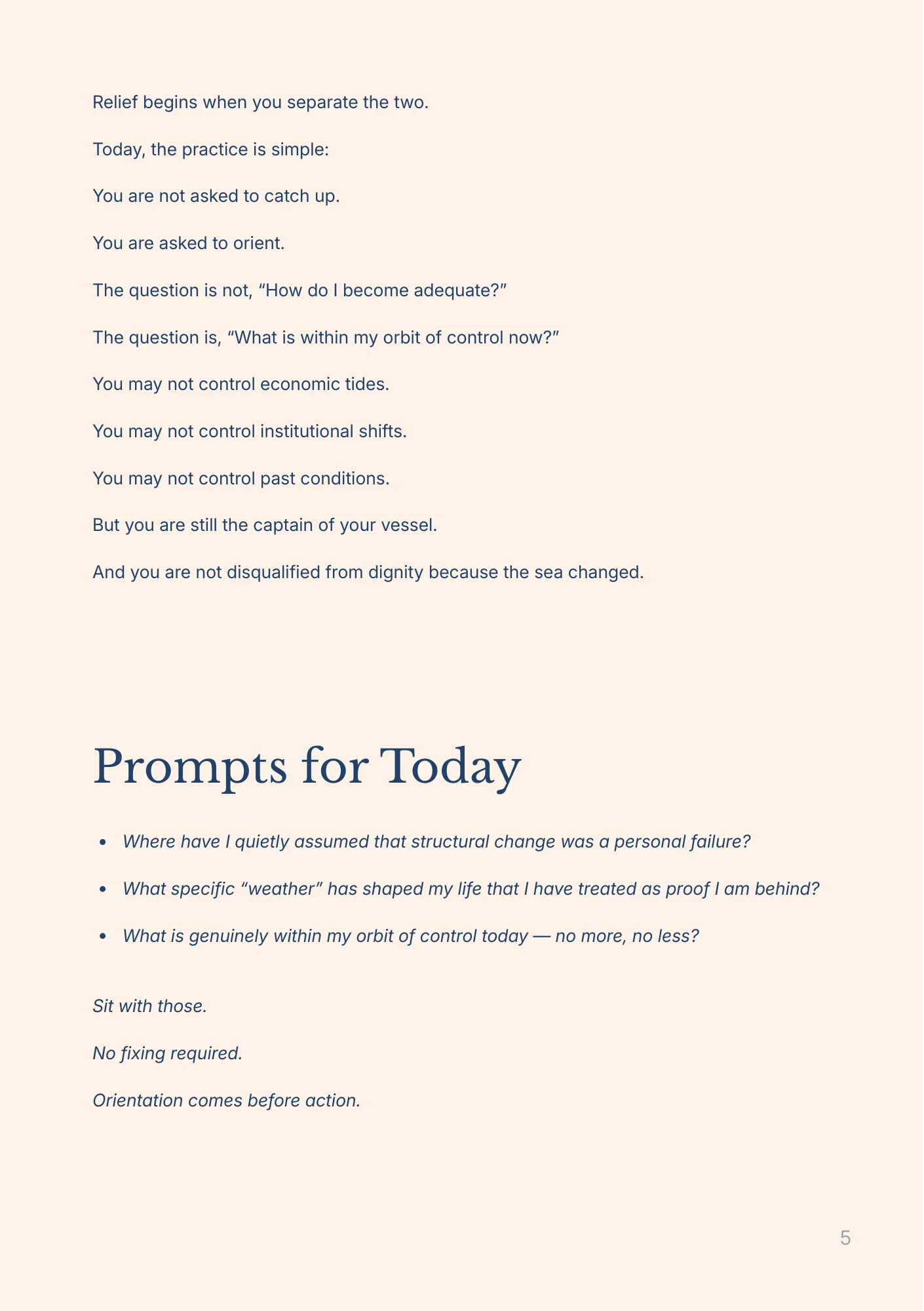
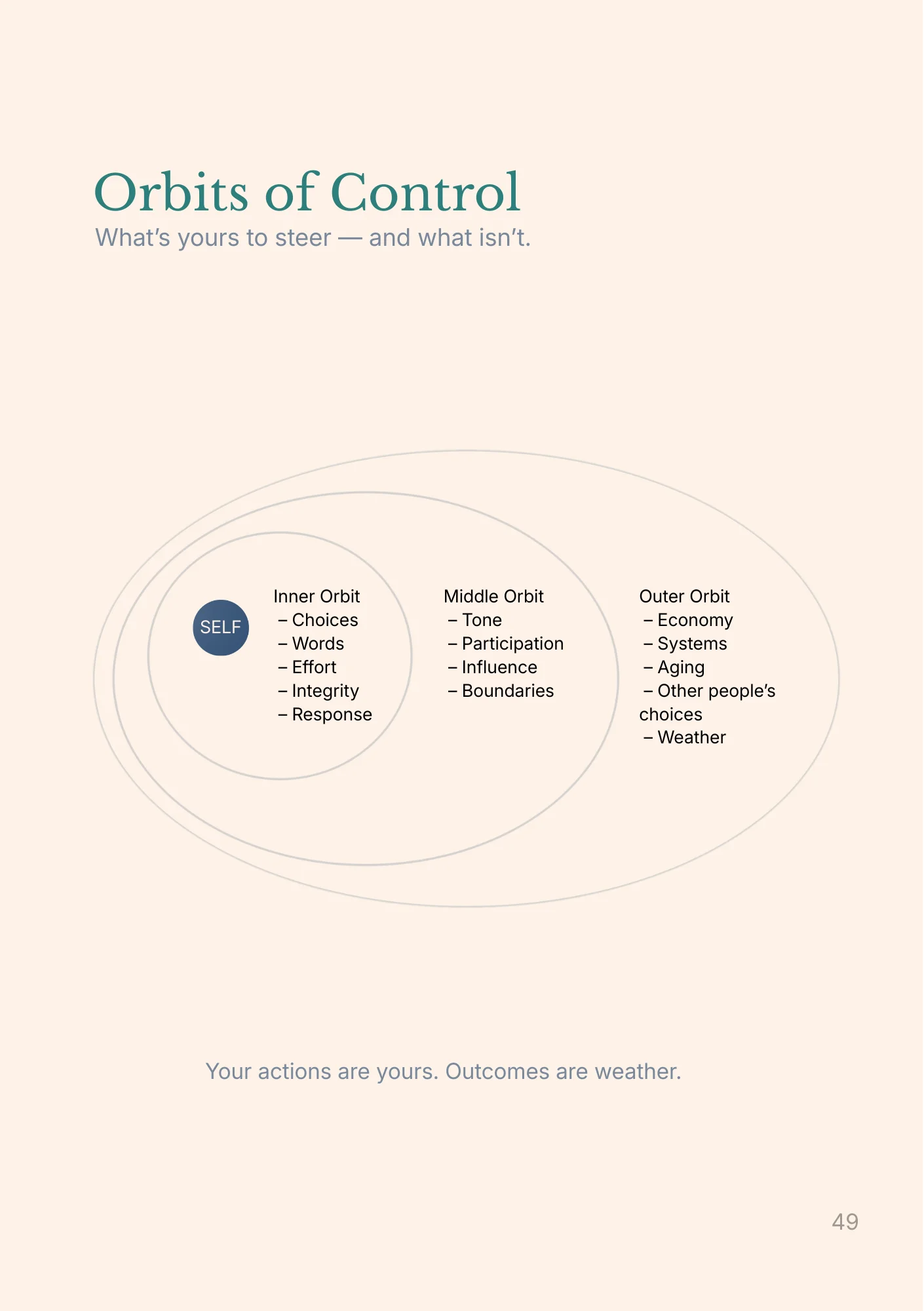
Clarify what is yours to steer — and what is weather
-
Release inherited shame without abandoning responsibility
-
Recognize worth as factual, not earned
-
Reduce comparison-driven pressure
-
Quiet the internal narrative that equates delay with defect
-
Take one steady, coherent step forward
Not in frenzy.
In proportion.
What’s Inside
This 50-page digital practice includes:
-
14 daily reflections intentionally structured to lower cognitive load and increase clarity
-
Grounded prompts designed for people under real pressure
-
A visual Orbit of Control summary for quick orientation
-
Movement from insight to stabilizing action
No hype. No performance demands.
Designed especially for thoughtful adults navigating economic shifts, health changes, midlife transitions, or quiet identity resets.
Why This Matters Now
Over the past decades, risk moved.
From institutions to individuals.
From stability to constant adaptation.
From shared structures to private burden.
Comparison became ambient.
Adaptation became constant.
Quiet self-doubt became normal.
Many responsible people internalized those shifts as personal failure.
This guide restores proportion.
You may need to adapt.
You may need to rebuild.
You may need to ask.
But you do not need to earn your right to exist.
Is This For You?
This practice is for you if you:
-
Feel capable but quietly behind
-
Are thoughtful and self-aware
-
Want clarity without motivational noise
-
Want strength without superiority
-
Want dignity without denial
This is not for you if you:
-
Want aggressive performance systems
-
Want productivity hacks
-
Want emotional intensity as fuel
Product Details
Format: Digital PDF
Length: 50 pages
Designed for screen or print (A5 format)
Price: $42
About the Author
David M. Blood writes at humia.life about dignity, systems, and agency in a culture that often confuses performance with worth.
This practice reflects years of examining how systems, inherited narratives, and perception shape the way people interpret their own value. It grows out of lived experience — including health limitations, financial uncertainty, and midlife recalibration — not abstract theory.